
What Are Emotions, Really?
A therapist explains common misconceptions & how you have more authorship over your experience than you think.
We often view emotions as inborn reactions that happen to all of us in the same way.
We make the following assumptions:
-Certain emotions such as fear, anger, sadness, and happiness are “innate” and universally recognized.
-Emotions have distinct biological processes.
-Emotions have distinct facial and body expressions and you can "read" someone's emotions from their face or body language.
What the Research Actually Shows:
-There are significant cultural differences in emotion. Certain cultures have emotion concepts that others do not. For instance, traditional Tahitian culture lacks a concept for sadness.
-Neuroimaging shows that certain emotions are not localized to certain brain areas, but involve diverse, overlapping neural networks.
-There is no consistent body signature for any emotion. We can't reliably "read" emotions from faces. Research shows facial movements vary enormously — even for the same emotion in the same person.
What does it mean if research can’t “locate” emotions or find the same emotions across different cultures?
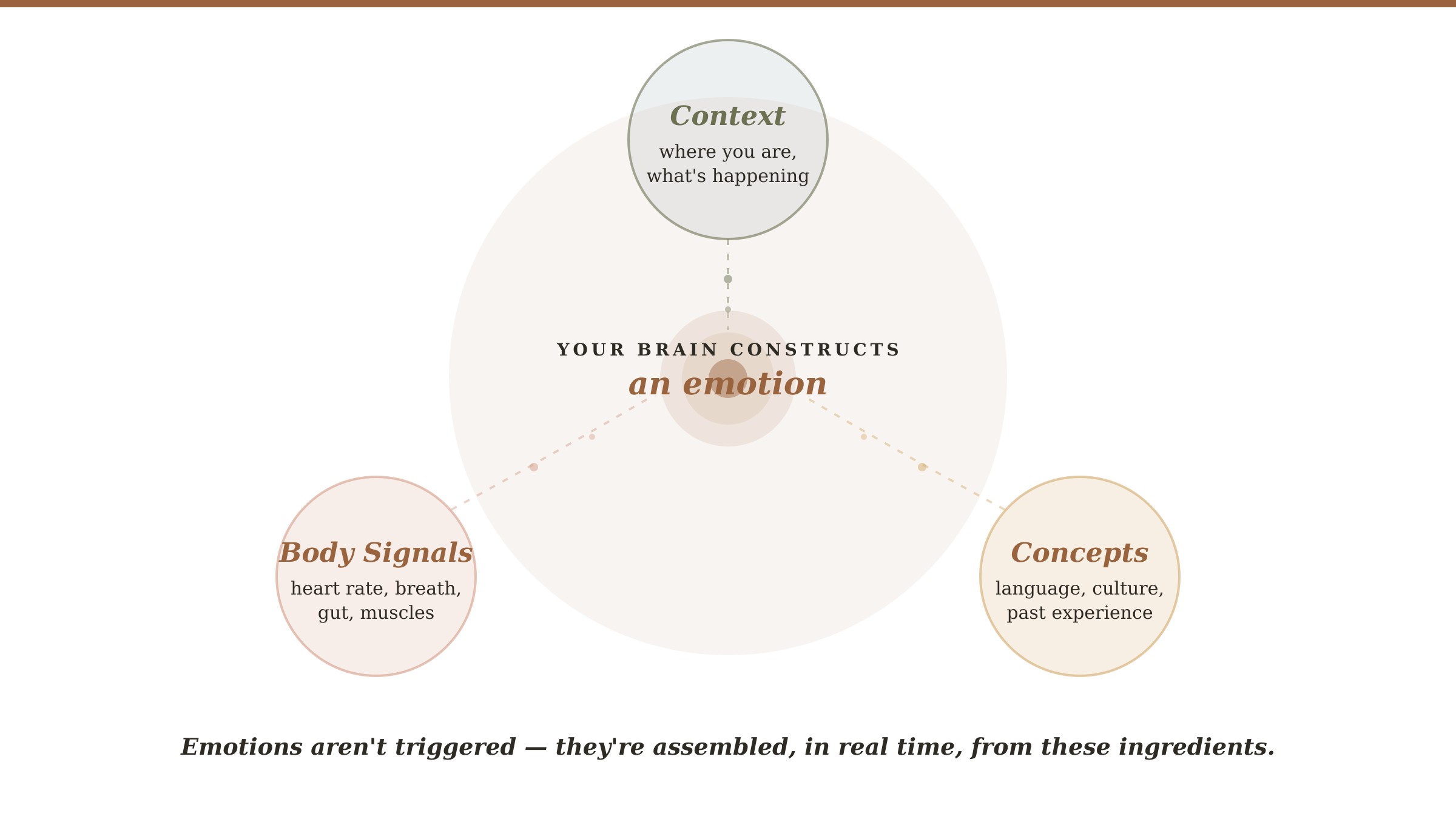
Lisa Feldman Barrett’s Theory of Constructed Emotion proposes that emotions are constructed experiences created by the brain, rather than pre-programmed reactions.
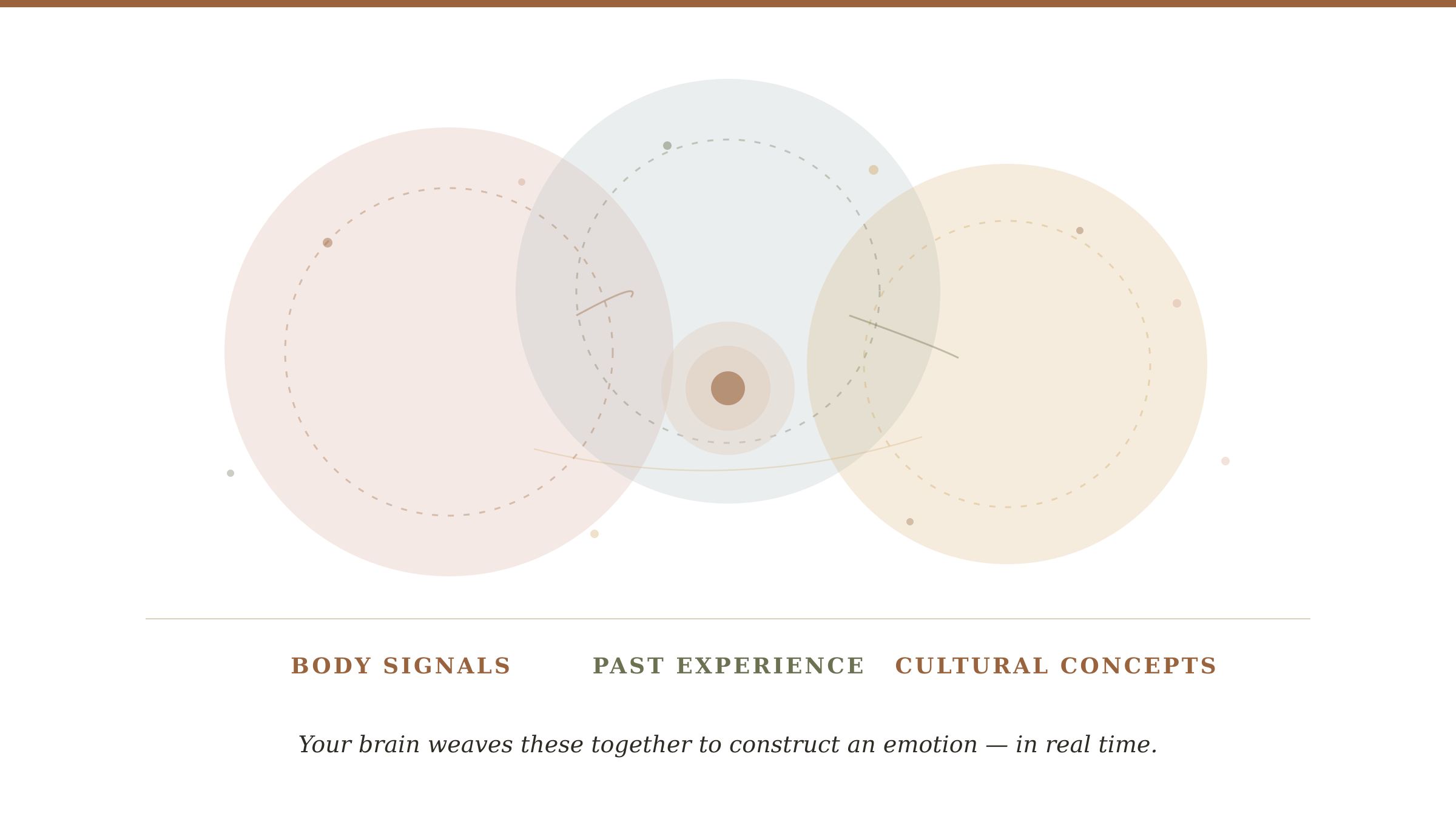
Your brain doesn't passively detect emotions — it creates them. It uses past experience, language, context, and cultural concepts to transform raw body signals into a specific emotion like "anger" or "excitement."
So, why does it matter, practically, that emotions are constructed experiences?
This matters for three reasons:
1.Growing your knowledge of emotion concepts can change your experience. More nuanced concepts of emotion give the brain more options when it's constructing an experience, which tends to produce more context-appropriate responses.
People who make finer emotional distinctions tend to be better at regulating their emotions, less reactive to stress, less likely to use maladaptive coping strategies, and more flexible in how they respond to difficult situations.
2. We can approach regulation in a new way.
-We can question the label of an emotion, rather than being “stuck” with it. We can ask, “Is this really anger, or am I actually exhausted and hungry?"
-We can deliberately expose ourselves to new experiences. If your past experiences have been shaped by chronic stress, trauma, or a limited emotional vocabulary, your brain's predictions may be systematically skewed — seeing threat where there is none, or constructing the same narrow set of emotional responses across very different situations. Since these are constructions and not hardwired reflexes, they can be updated.
3. We Can More Easily Cultivate Compassion (for ourselves and others)
If we understand that someone's emotional response isn't a fixed, inevitable reaction but a construction shaped by their unique history, body state, and conceptual repertoire, it becomes easier to approach differences with curiosity rather than judgment.
For yourself, it means a difficult emotional pattern isn't a permanent feature of who you are — it's a habit of construction that can, with effort and the right conditions, be reshaped over time.
Interested in exploring these themes together?
I work with clients in Colorado, Texas, and Florida.
Reach out via the contact page if interested.

Morgan E. Rutter, LPC
